Figuratio
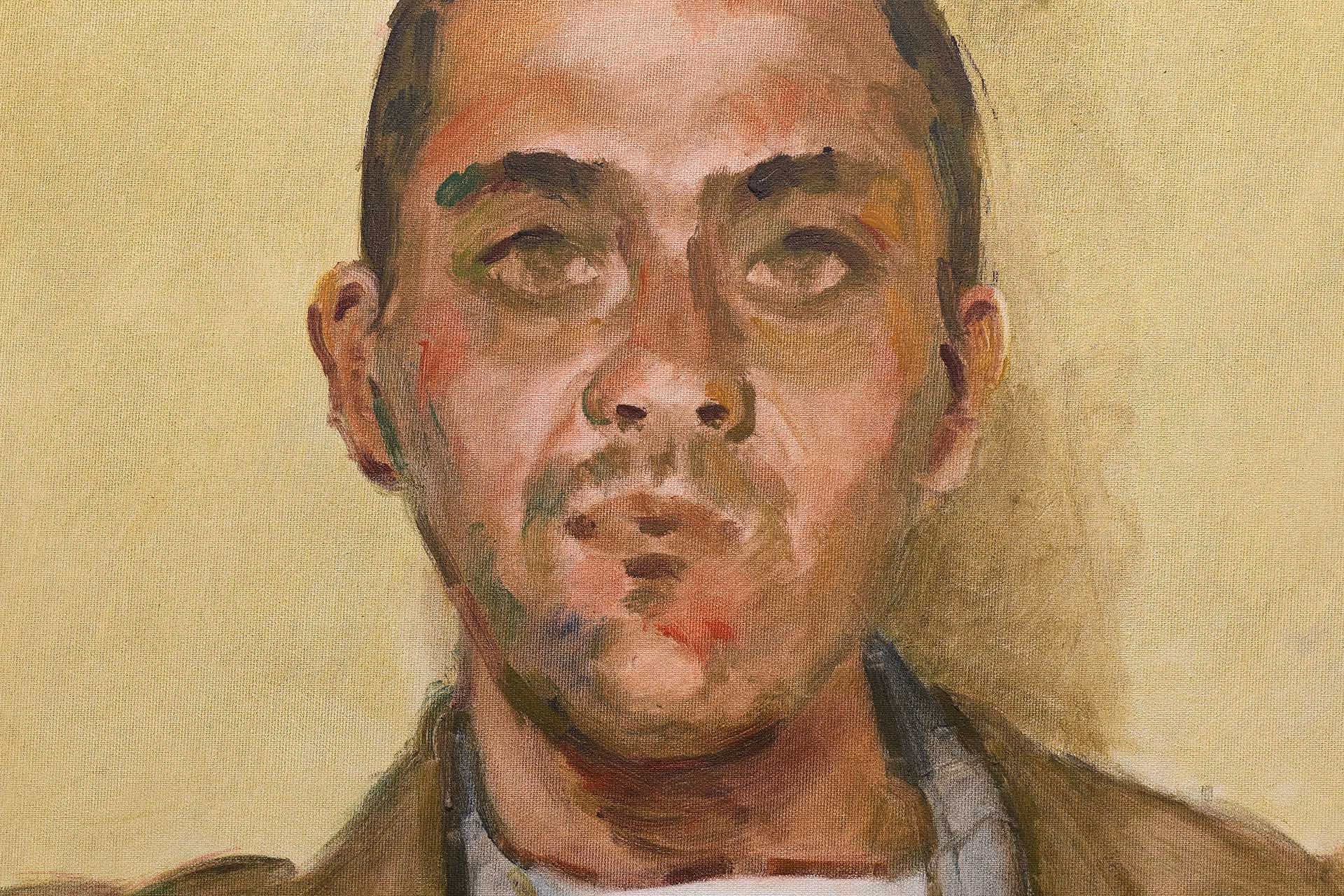
Charles Laib Bitton
Dear Visitor,
At the request of the artist, no official gallery text accompanies these works.
It is the artist’s wish that the work be experienced as freely and intuitively as possible.
Instead of a single authoritative voice, we present you with different encounters by different individuals.
These are personal and not a guide.
The artist encourages you to value your own experience, which is part of the work itself.
The artist and us thank you for your visit.
Having explored the human figure through the formal abstractions of his earlier works (exhibitions such as “Eveil passager,” “Romantic Imagism,” and “I told you when I came I was a stranger”), as a half-open window onto the mysteries of the human soul, Charles Laib Bitton continues his quest for the essential – for the significance of the gesture and the present moment – to dispel the illusion and the omnipresence of the virtual in our society, and to respond, through a refreshing break from the norm, to the urgency of the senses and emotions. Those evoked by bodies powerfully embodied in a physical reality that is tranquil and benevolent.
To paint what is, relentlessly and unvarnished, in all its diversity, multiplicity, obvious existence, physicality, and infinite gentleness, within the simplicity of everyday life. To breathe new life into emotion through the line and the urgency of a liberated, vivid, incisive, instinctive pictorial gesture, without compromise or regret. For the artist, it is a matter of reconnecting with the greater whole, with universality, by celebrating the coexistence of humanity, the animal and plant kingdoms, and the material world.
An object, a body, a friend, a child, a pet… They are there, displayed, posed, illuminated by the same light at the moment of creation, frozen in the intensity of the instant, and linked by the magic of warm chromatic harmonies: shades of green, red, yellow ochre, sienna, and burnt umber, undoubtedly inspired by Italian Renaissance painting and the Florentine countryside where Charles Laib Bitton has been living for four years.
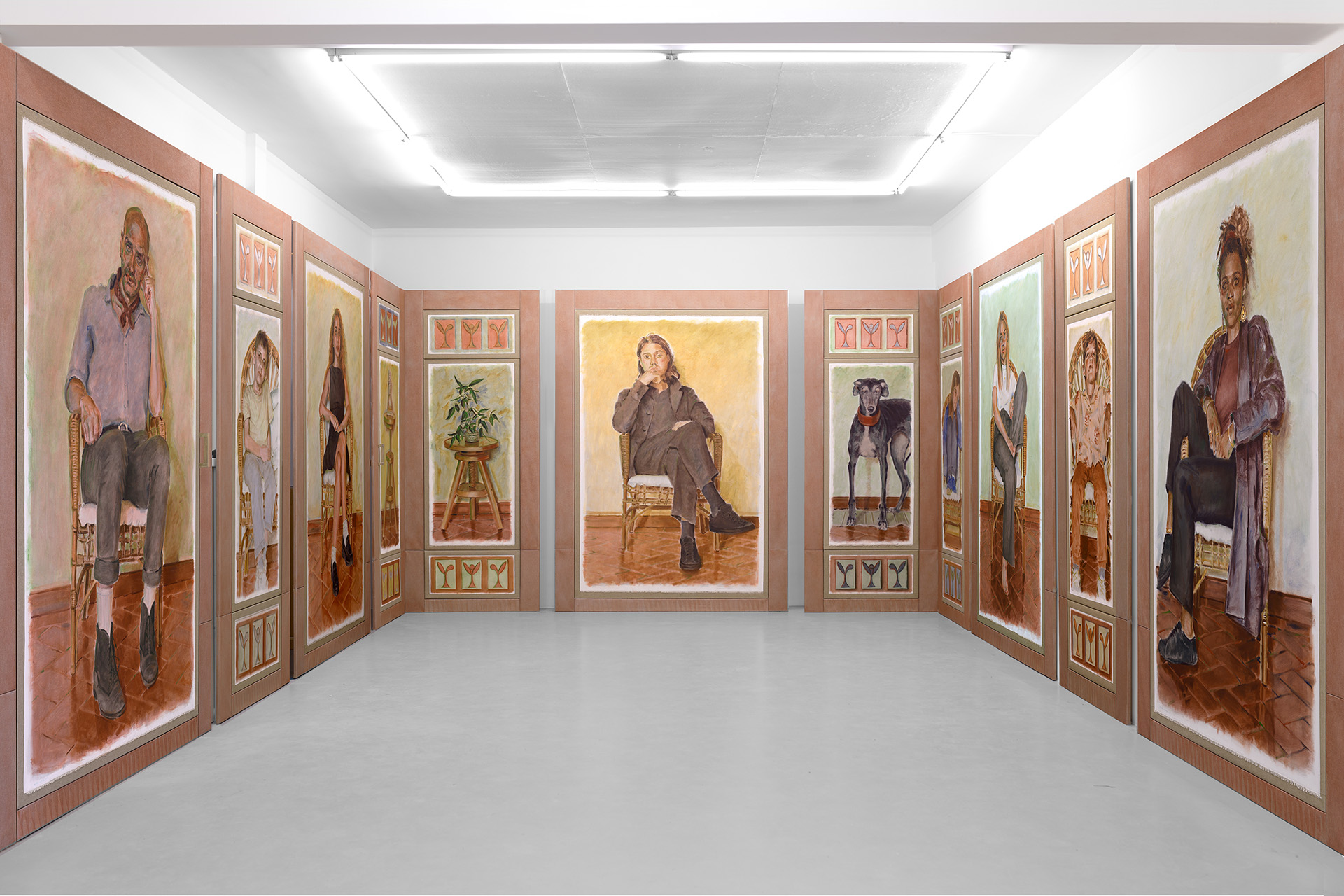
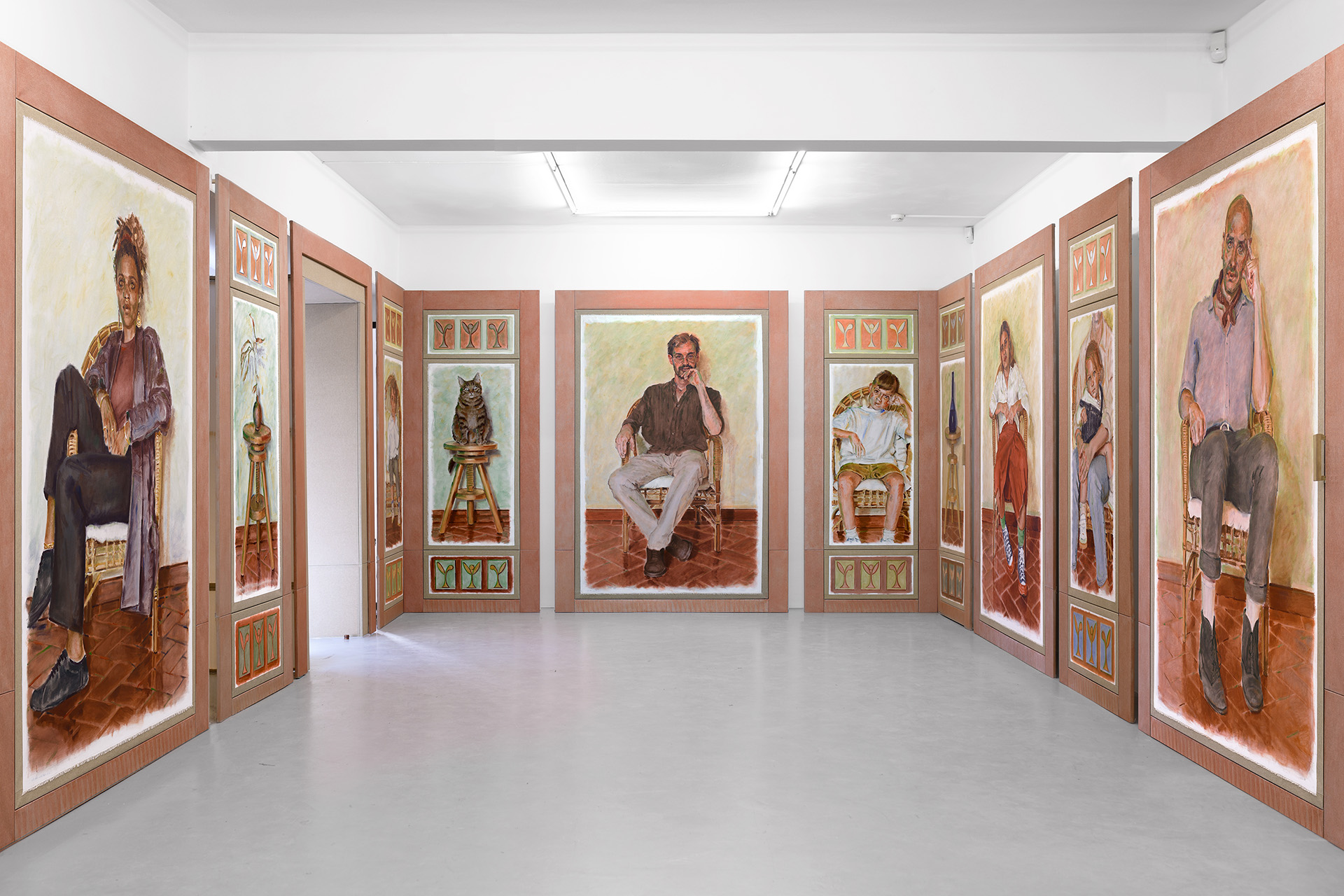
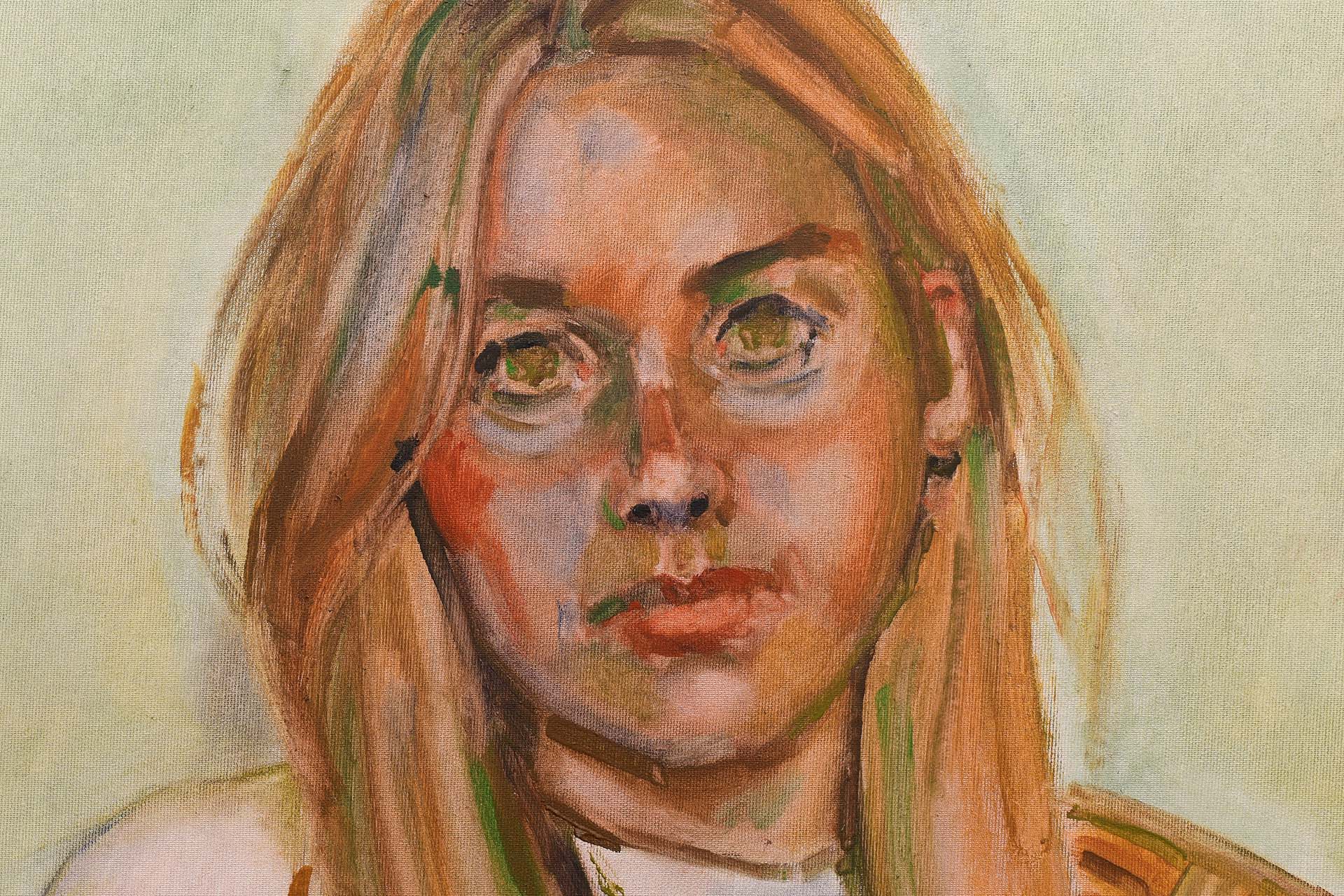
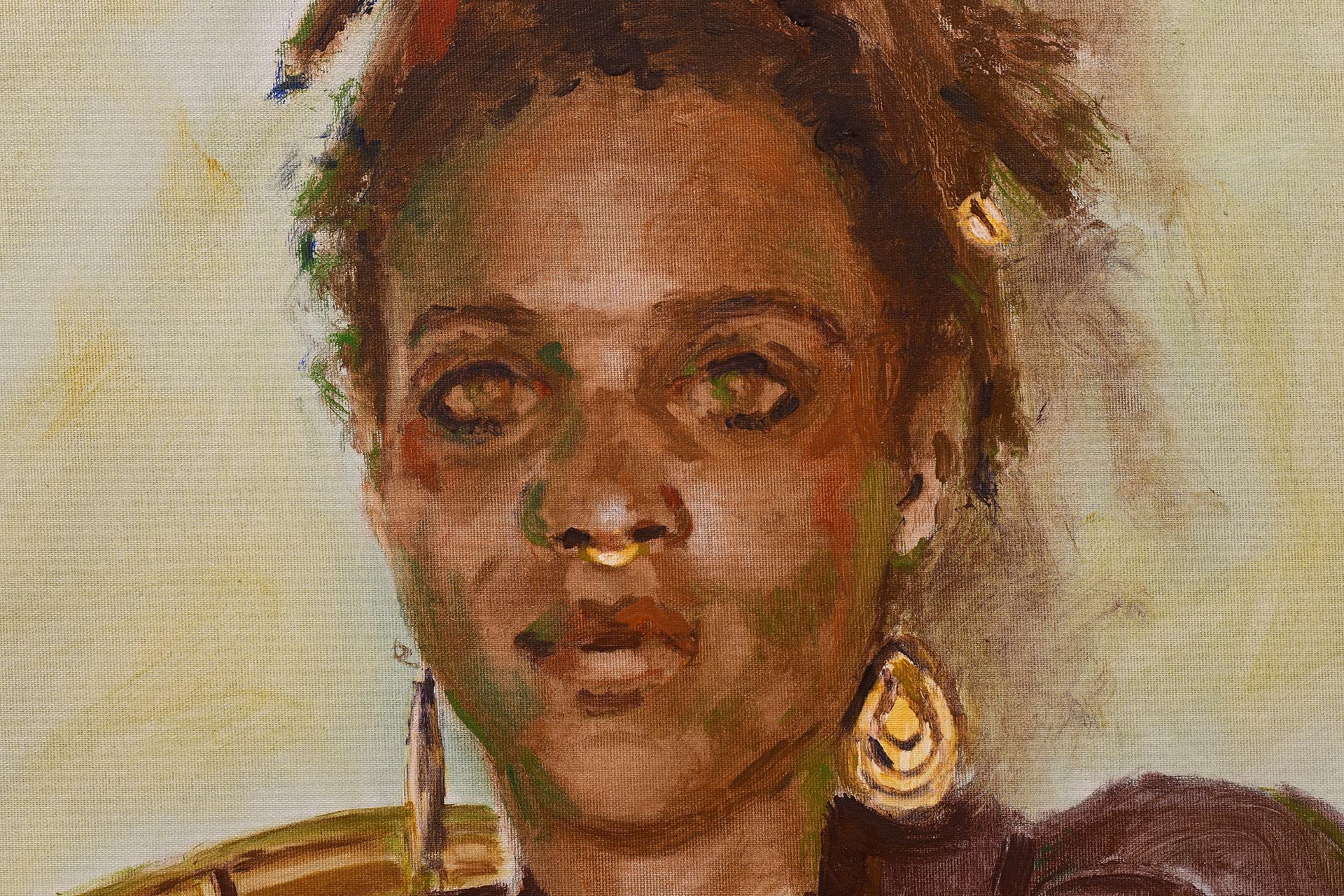
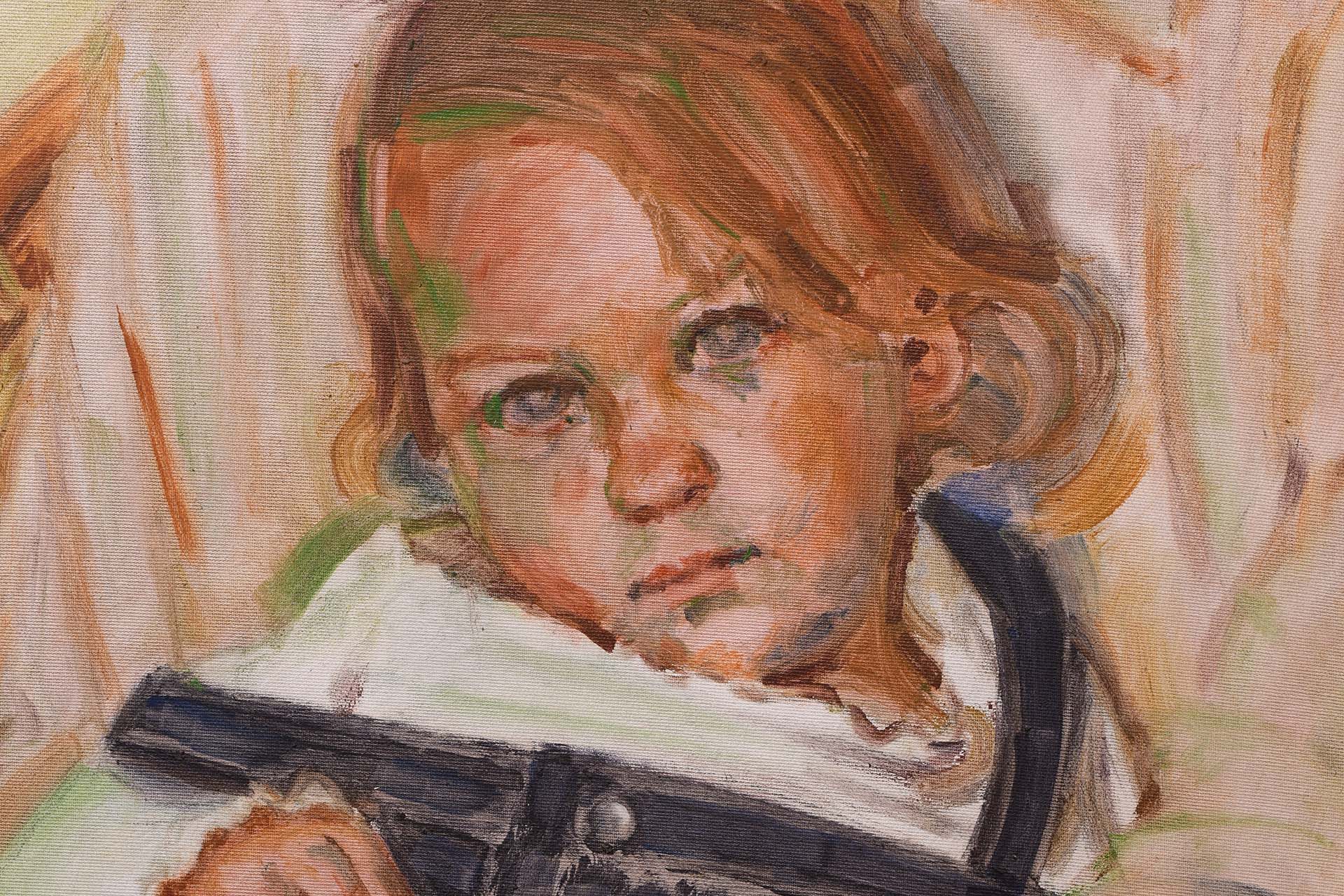
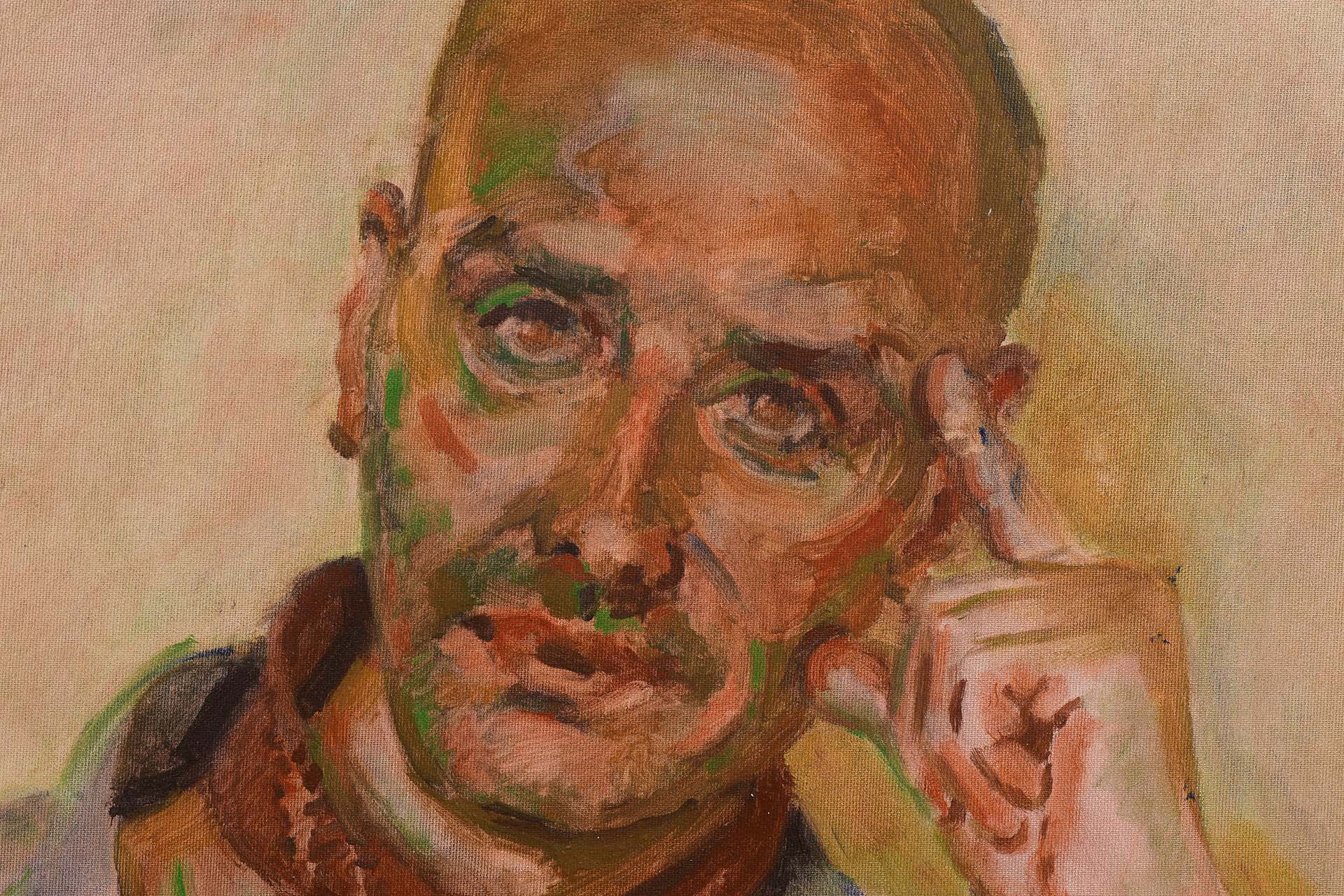
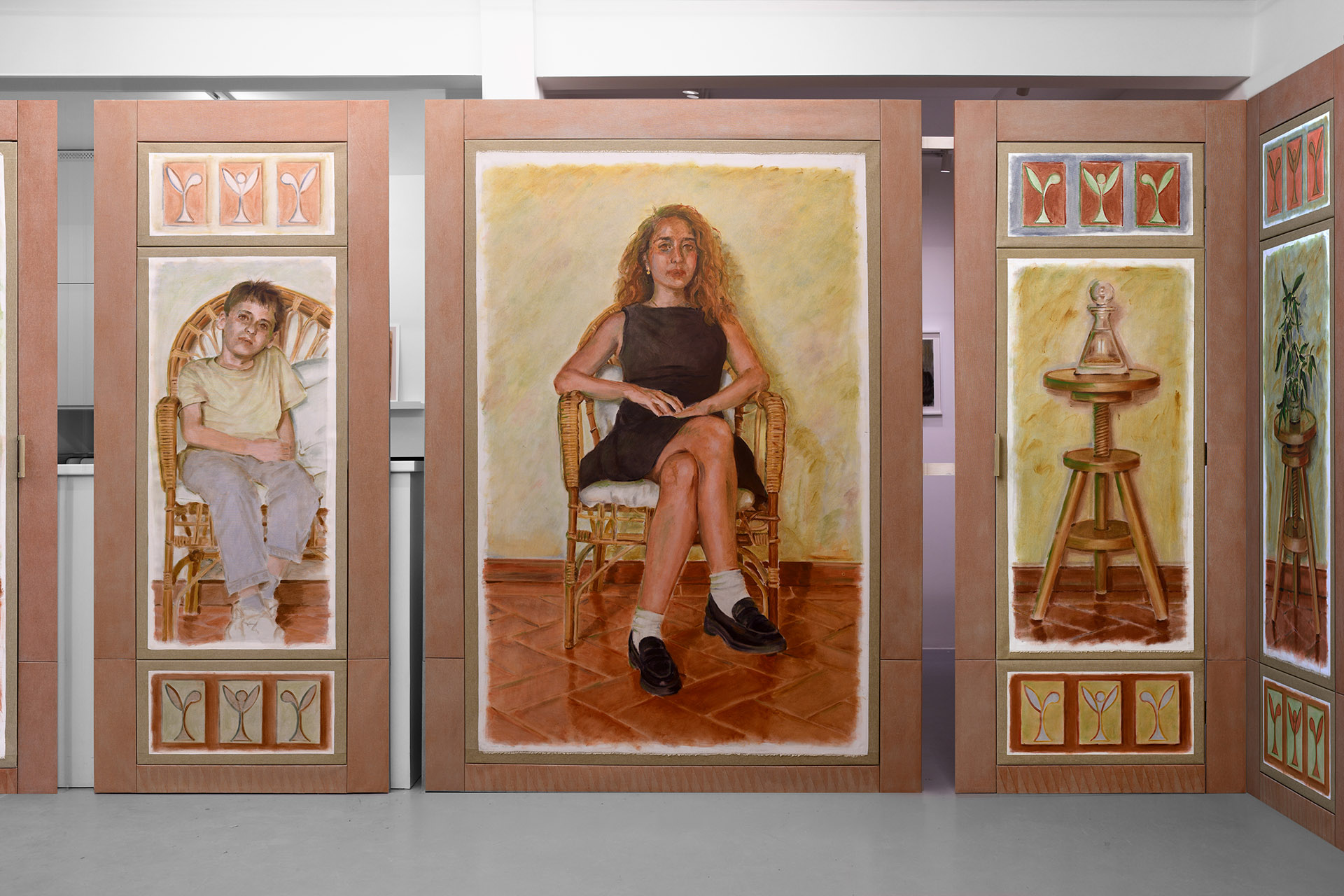
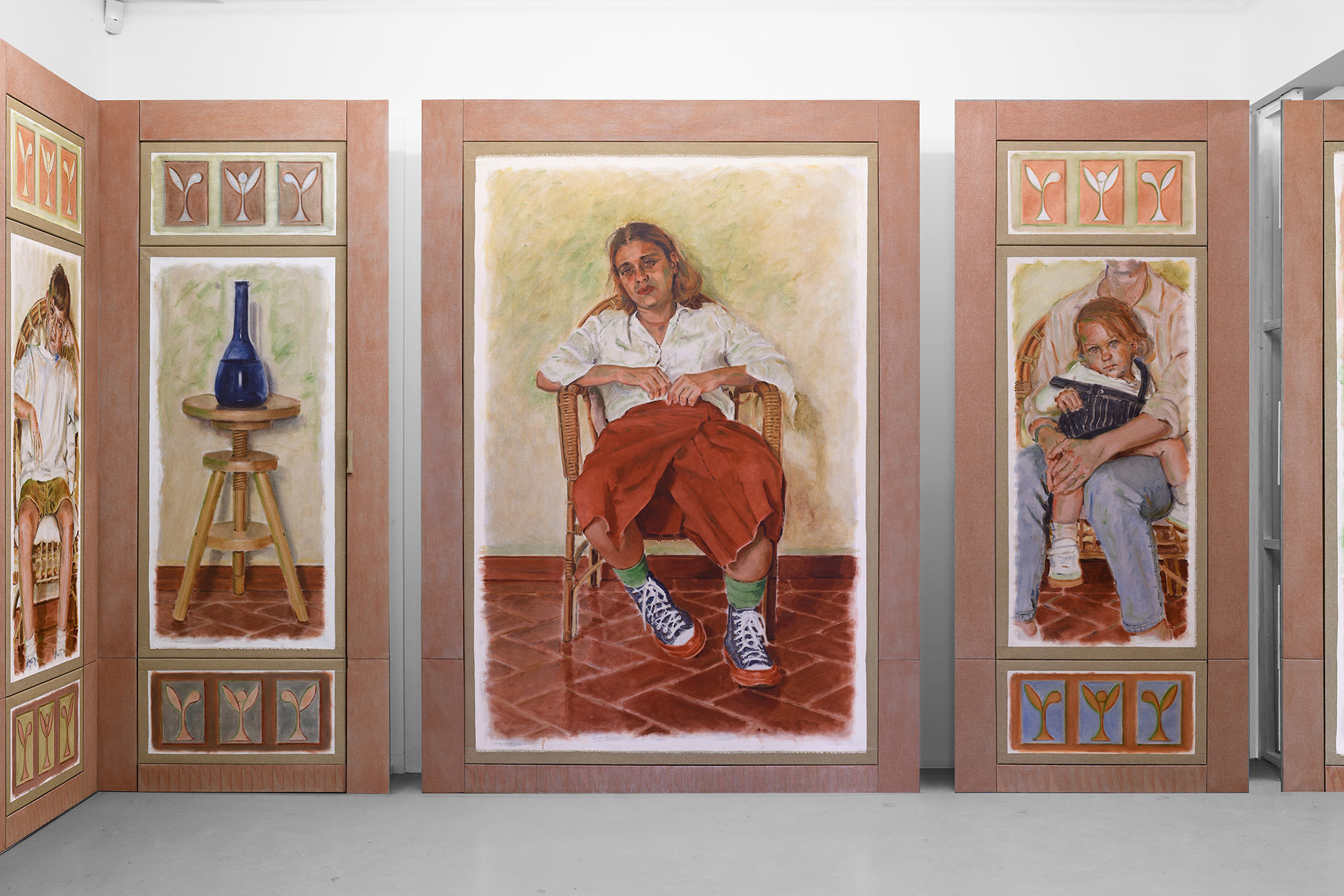
What are they thinking? What do they expect of us—these strange, silent witnesses frozen in time, emerging from the painted canvas, seated on the same chair, in the same spot, connected by the brick-red ceramic floor, unchanging and silent, and yet very much alive? They stare at us intently, with the force of their directness, in this very workspace, this studio, this place of memory, like a gallery of portraits and gigantic silhouettes, presiding over a patrician mansion from another era, elements of whose imaginary architectural decor can be found in the artist’s imagined scenography.
This space for wandering is at once unique and multifaceted, replicated, open yet enclosed, universal and personal, staged to the fullest in all its dimensions—both real and dreamlike—drawing its intrigues and mysteries from Florence’s past. In these melancholic gazes—by turns disillusioned, amused, dreamy, or scrutinizing, questioning and direct—we find an inner dialogue, today and forever, a tale of presences and absences, of intimacy that is alternately hidden or revealed to us, the passersby.
– Béatrice van SCHENDEL
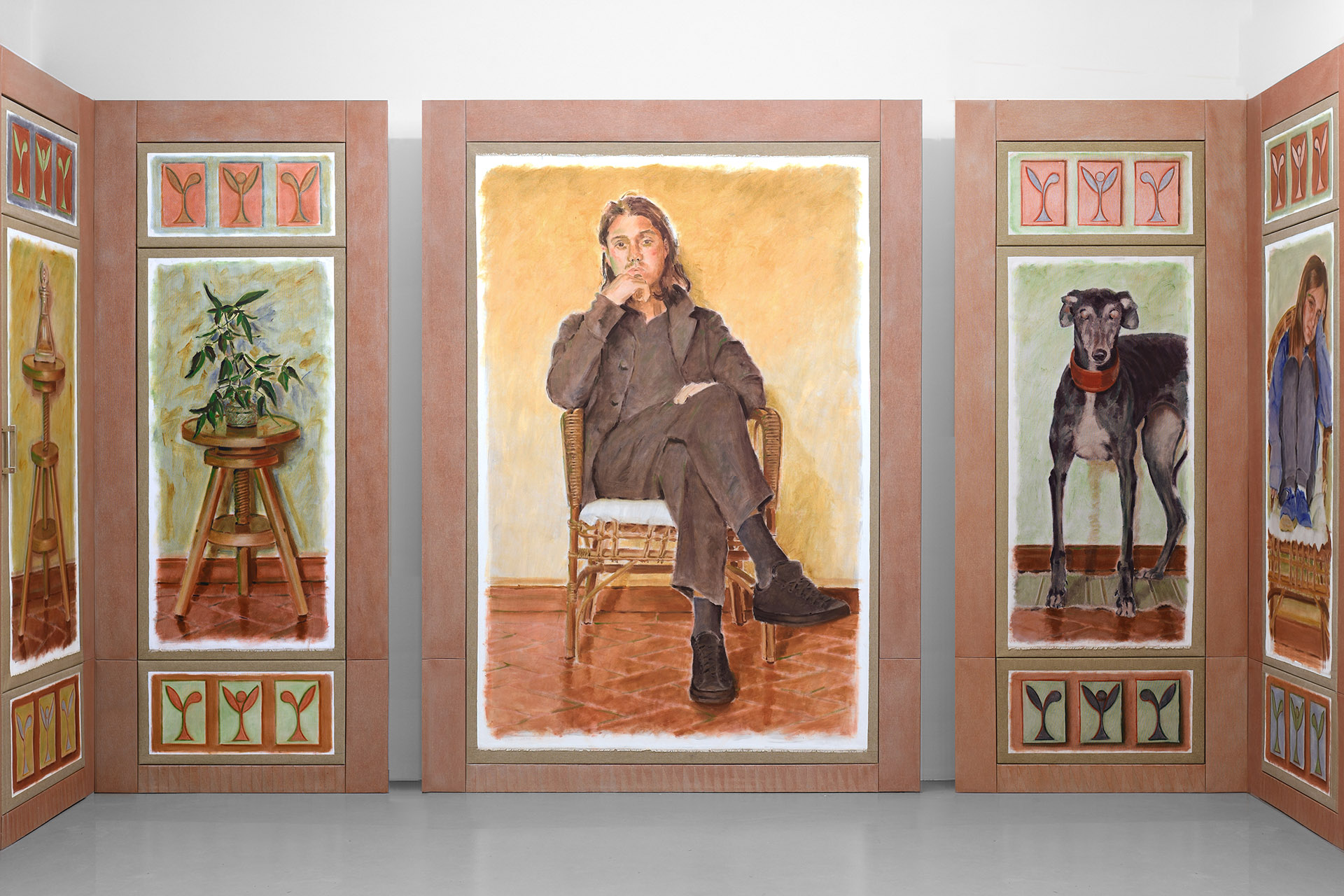
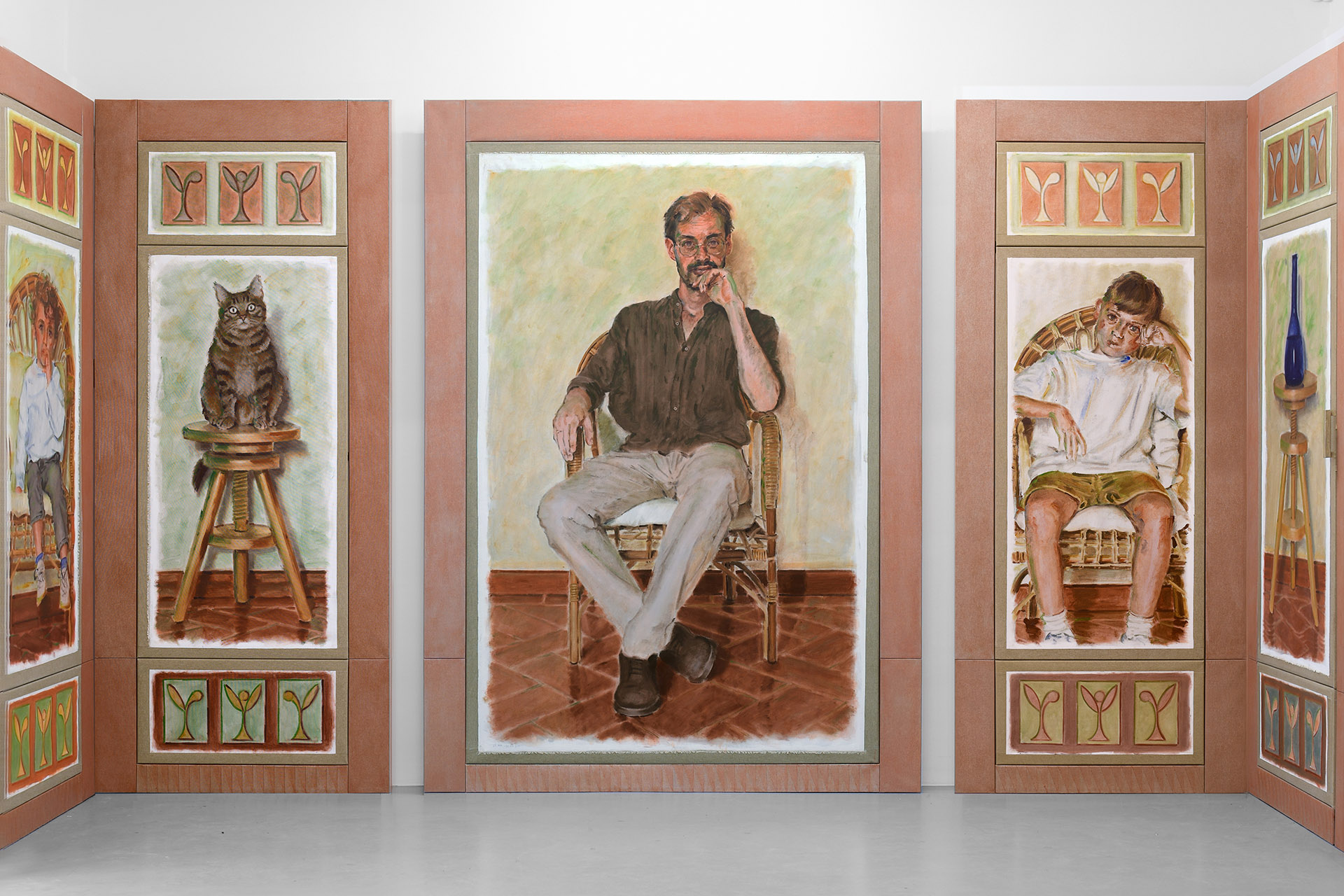
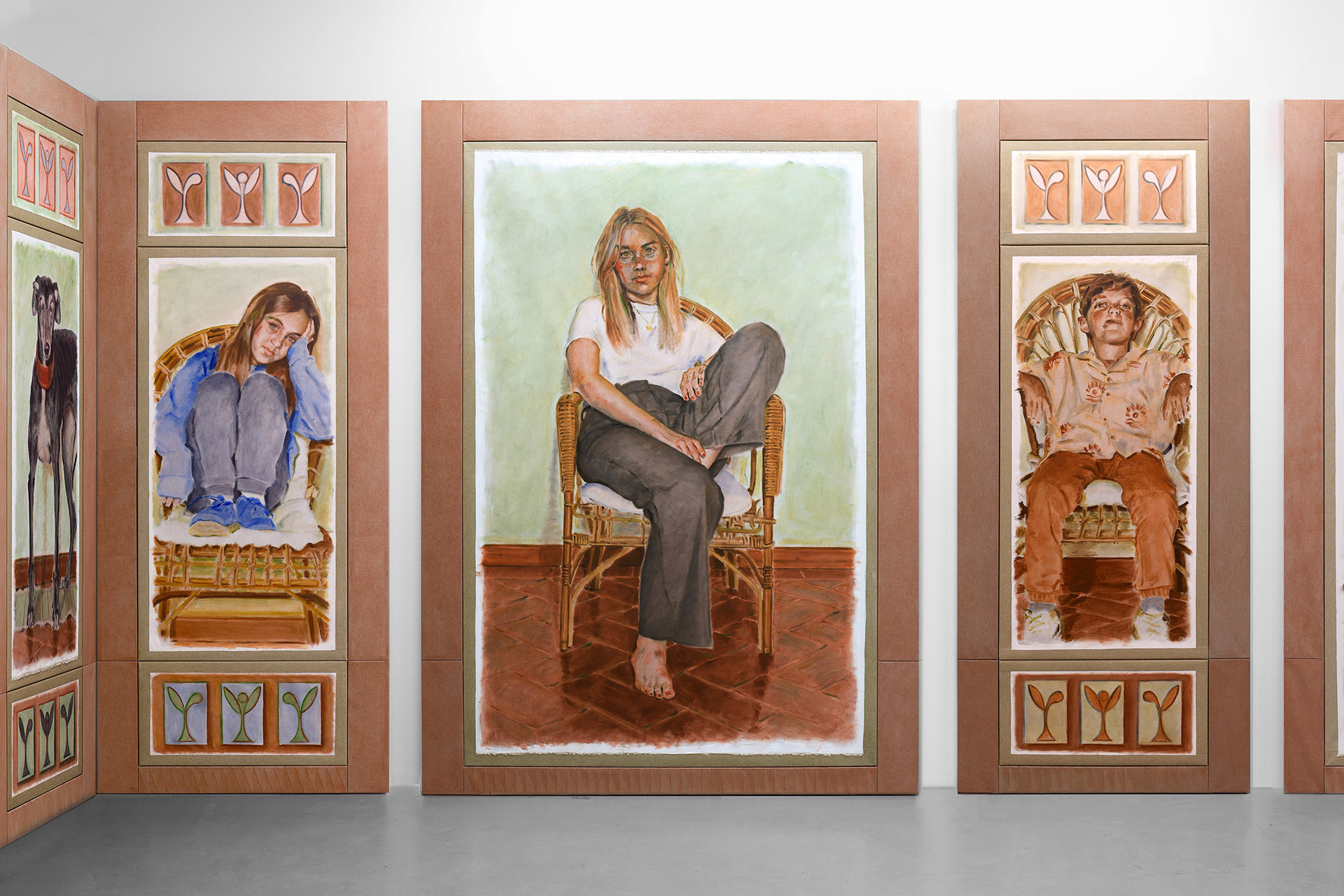
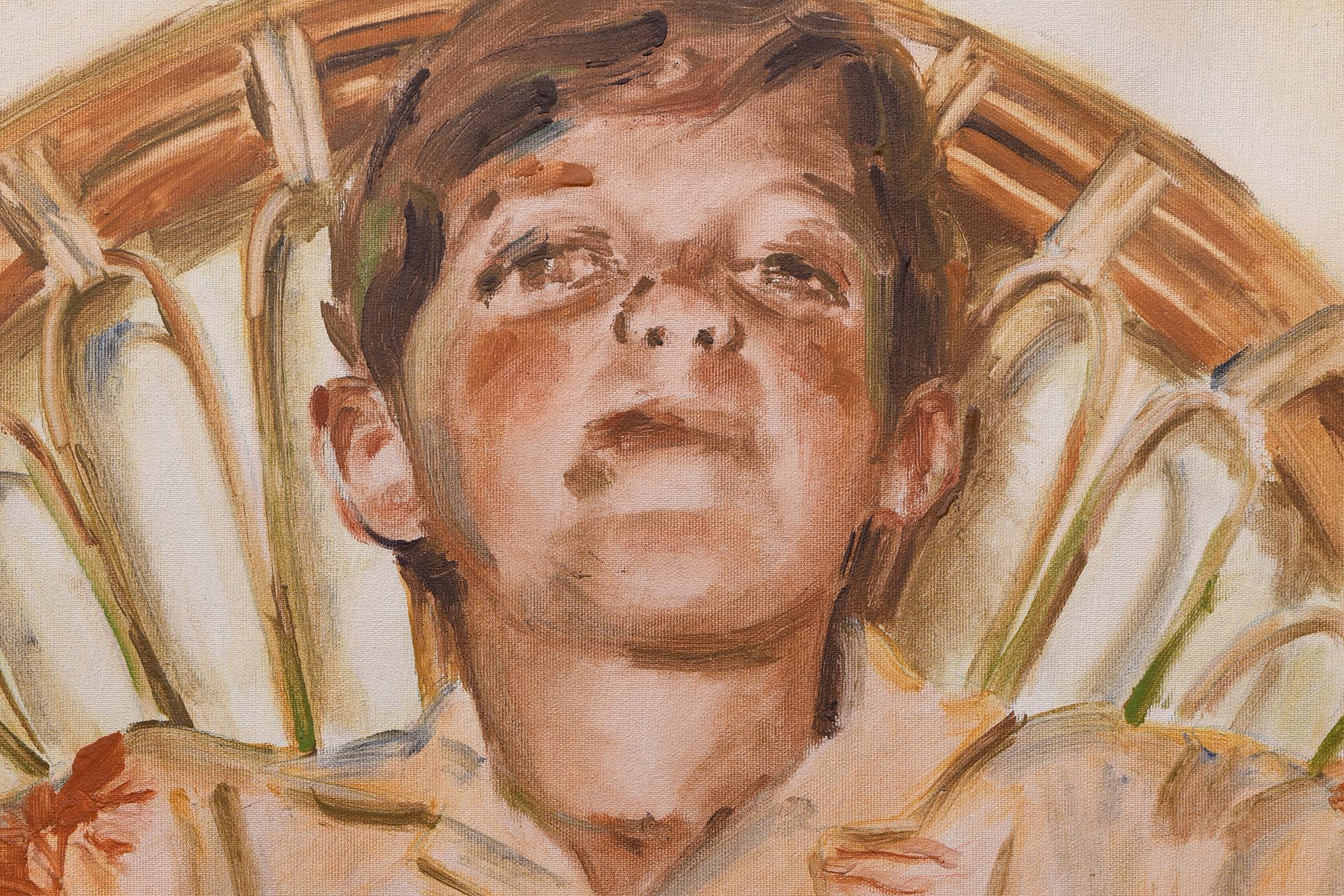
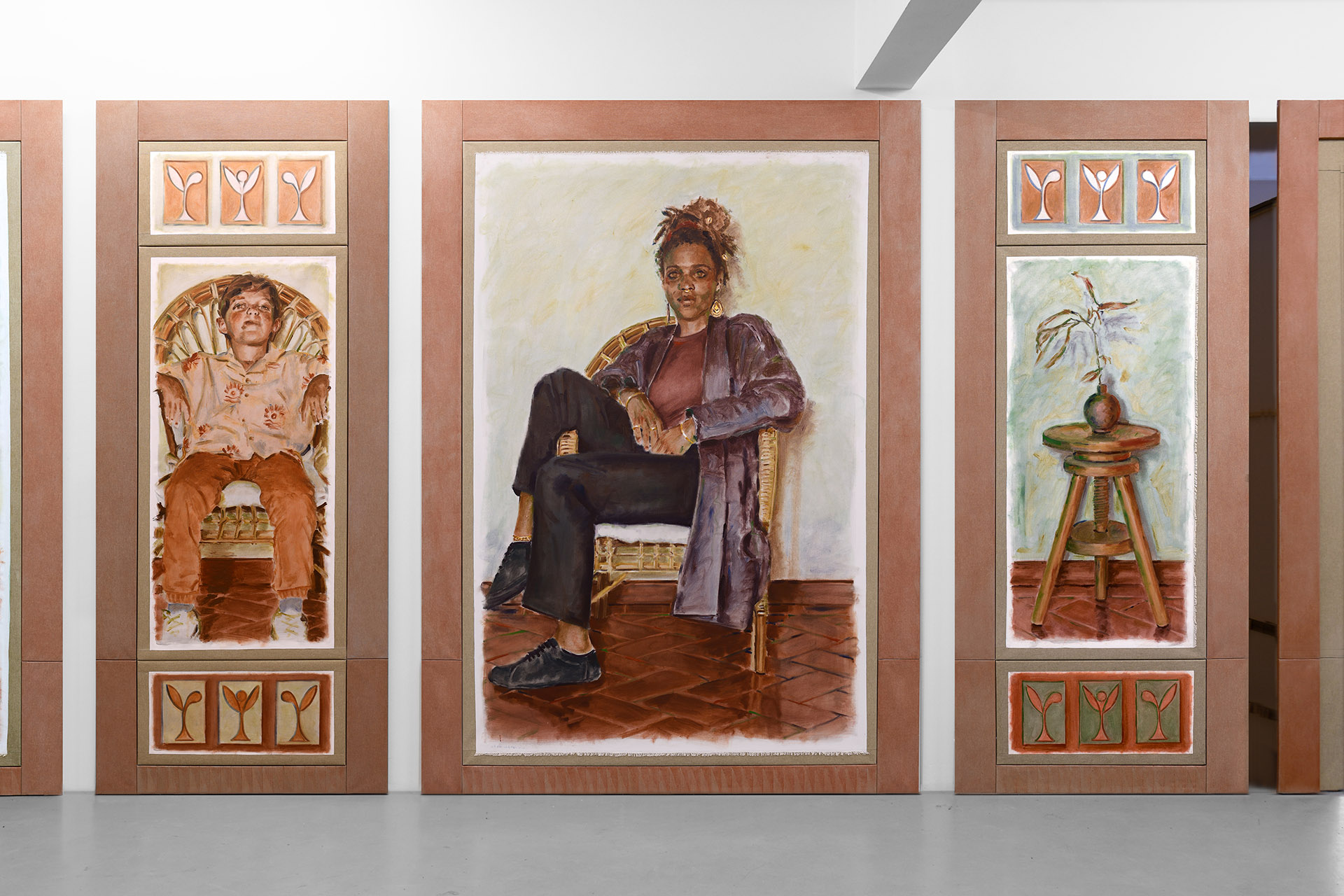
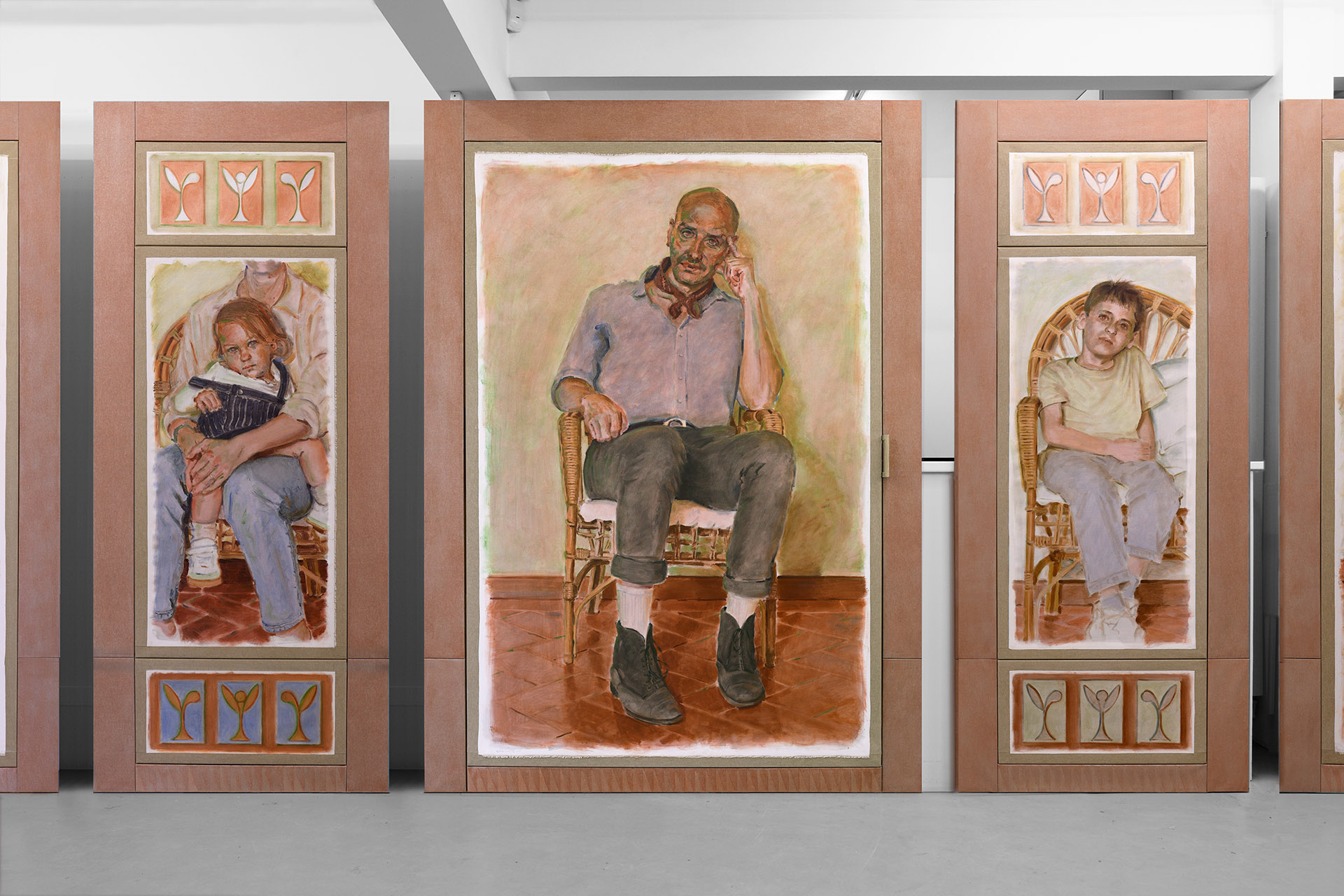
In Charles Laib Bitton’s paintings, nothing seems to try to dominate the scene. Children and adults sit on the same rattan chair, at the same height; animals, plants, and objects are arranged one after another on a studio stool. The floor—terracotta tiles—becomes a canvas for an almost geometric composition. All the figures appear against a light-colored wall, bathed in soft, natural light. All are rendered in a restrained palette, at times evoking the Italian Primitives, with a consistent economy of means. They are observed with equal attention, as if each presence were equivalent and demanded the same degree of patience and openness from the viewer.
This way of observing the world is reminiscent of the quiet attention Robert Walser paid to the most humble things. For the Swiss writer, walking, observing, or pausing before an ordinary detail becomes a way of inhabiting reality with intensity and humanity. Bitton’s paintings stem from a similar sensibility: they reject grandstanding and favor a relationship with the subject that requires a certain duration, a gradual adjustment of the gaze.
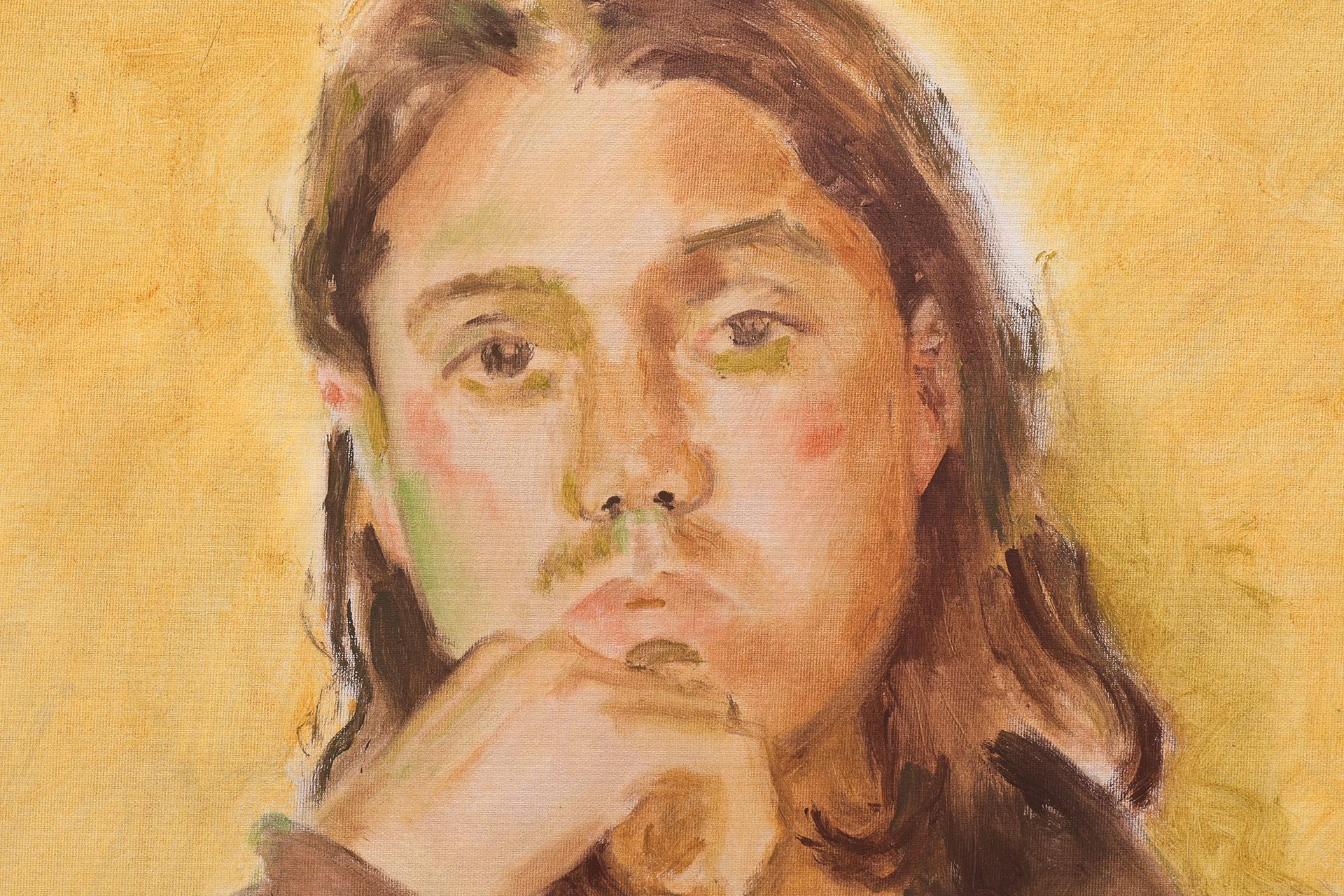
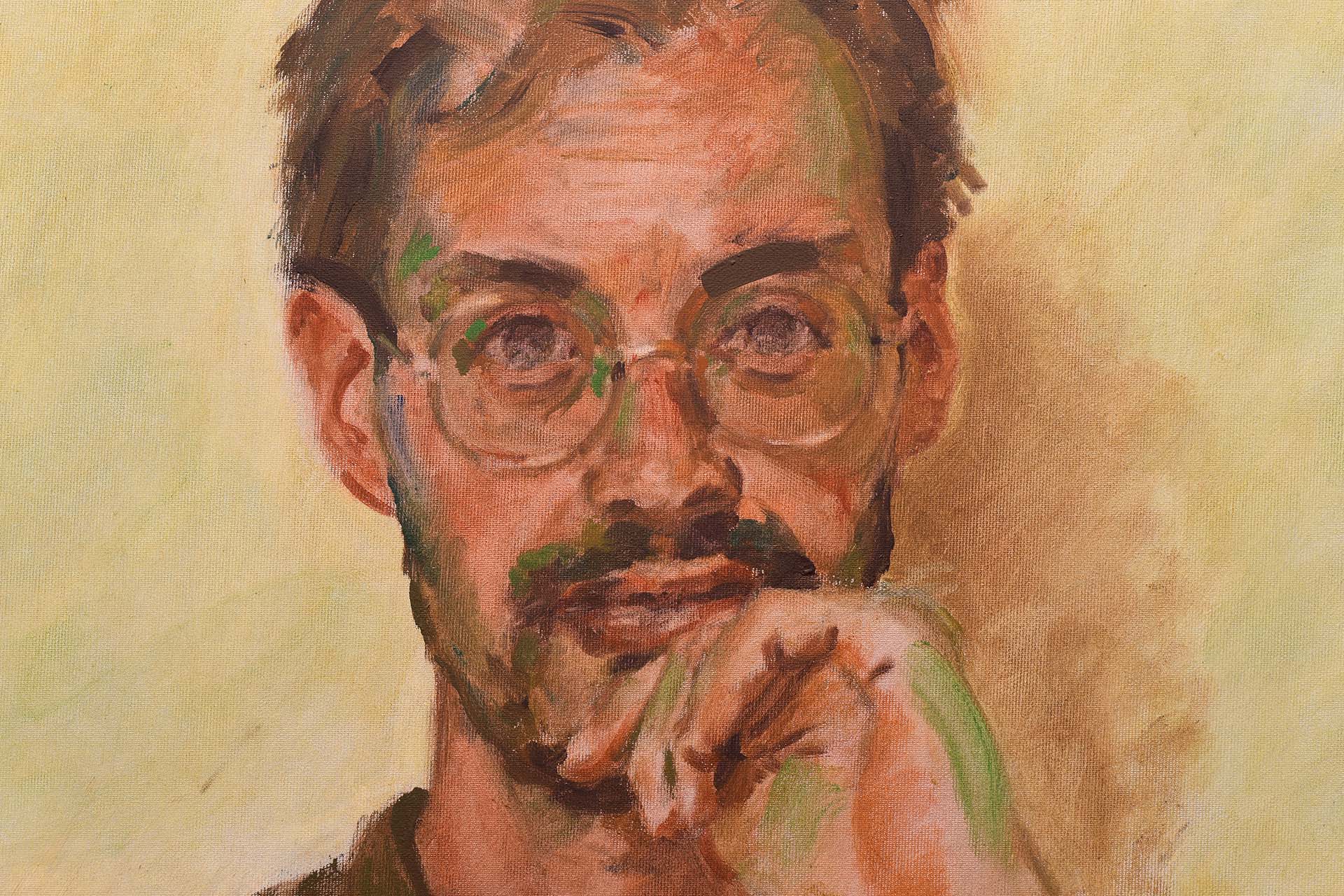
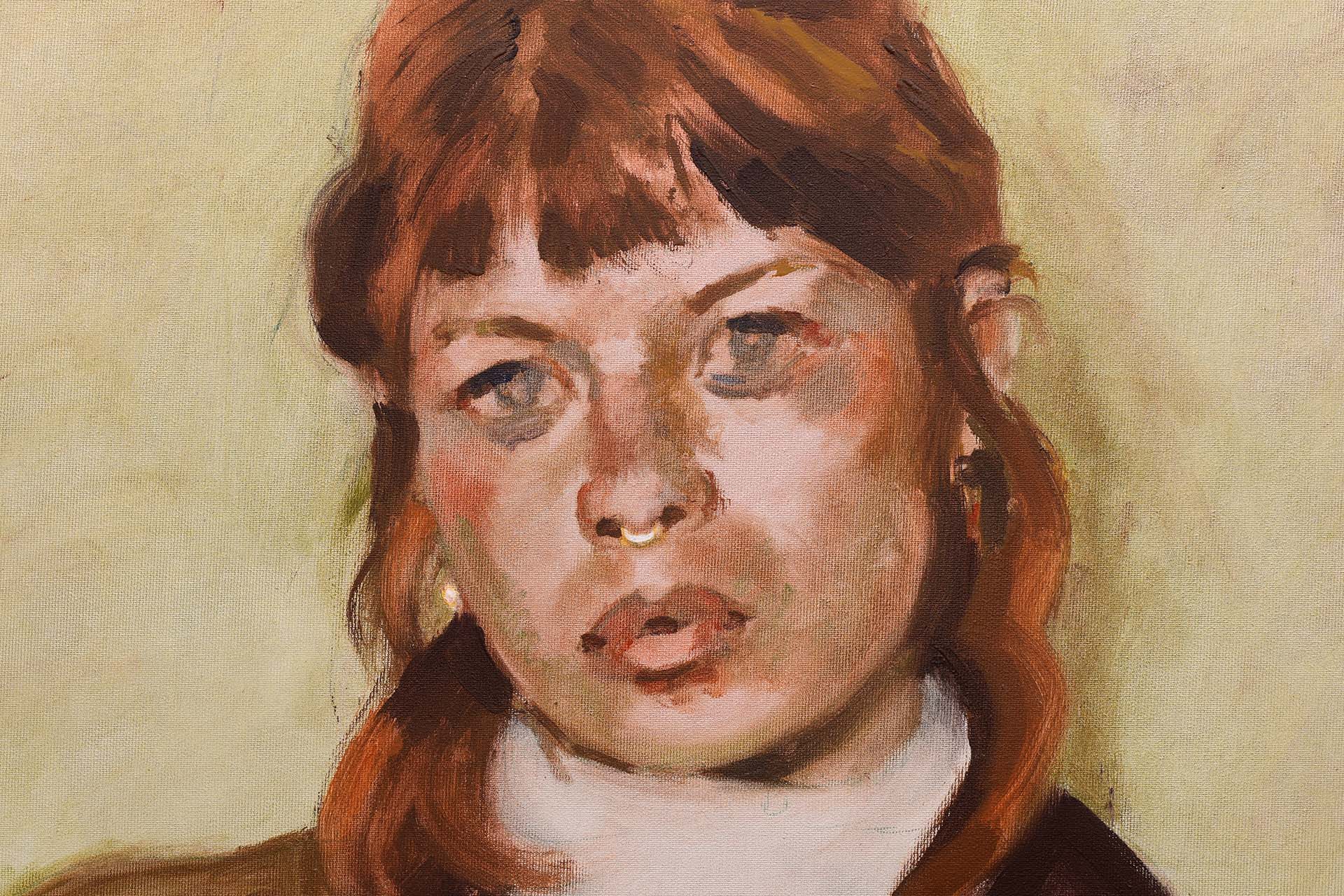
This apparent simplicity and closeness to the subject is, however, accompanied by a certain opacity. His figures are neither portraits in the strict sense nor archetypal representations. Rather, they appear as intermediary presences, emerging from a combination of observation, memory, and invention. Their slightly veiled gaze, as if held back behind the surface of the painting, echoes Richard Marienstras’s description of the Golem: a creature almost human in appearance, whose strangeness is betrayed only by a slight alteration. The figures painted by Bitton possess something of this ambiguity. Is it because they carry within them a certain incompleteness, the same mutilation as the Golem? Motionless and pensive, adopting the traditional postures of melancholy and rendered with touches of verdaccio, they gaze toward the viewer; familiar, yet never quite graspable.
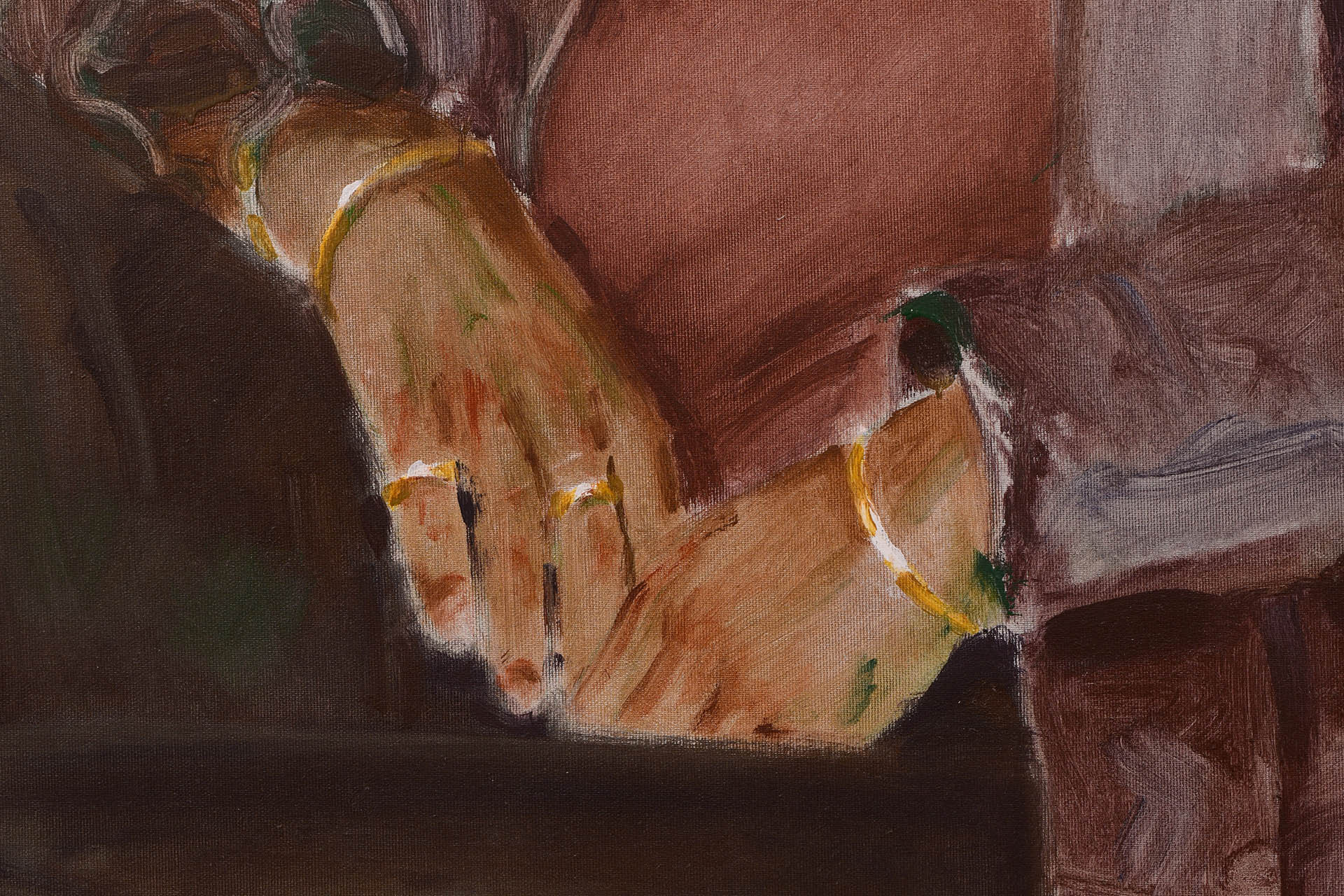
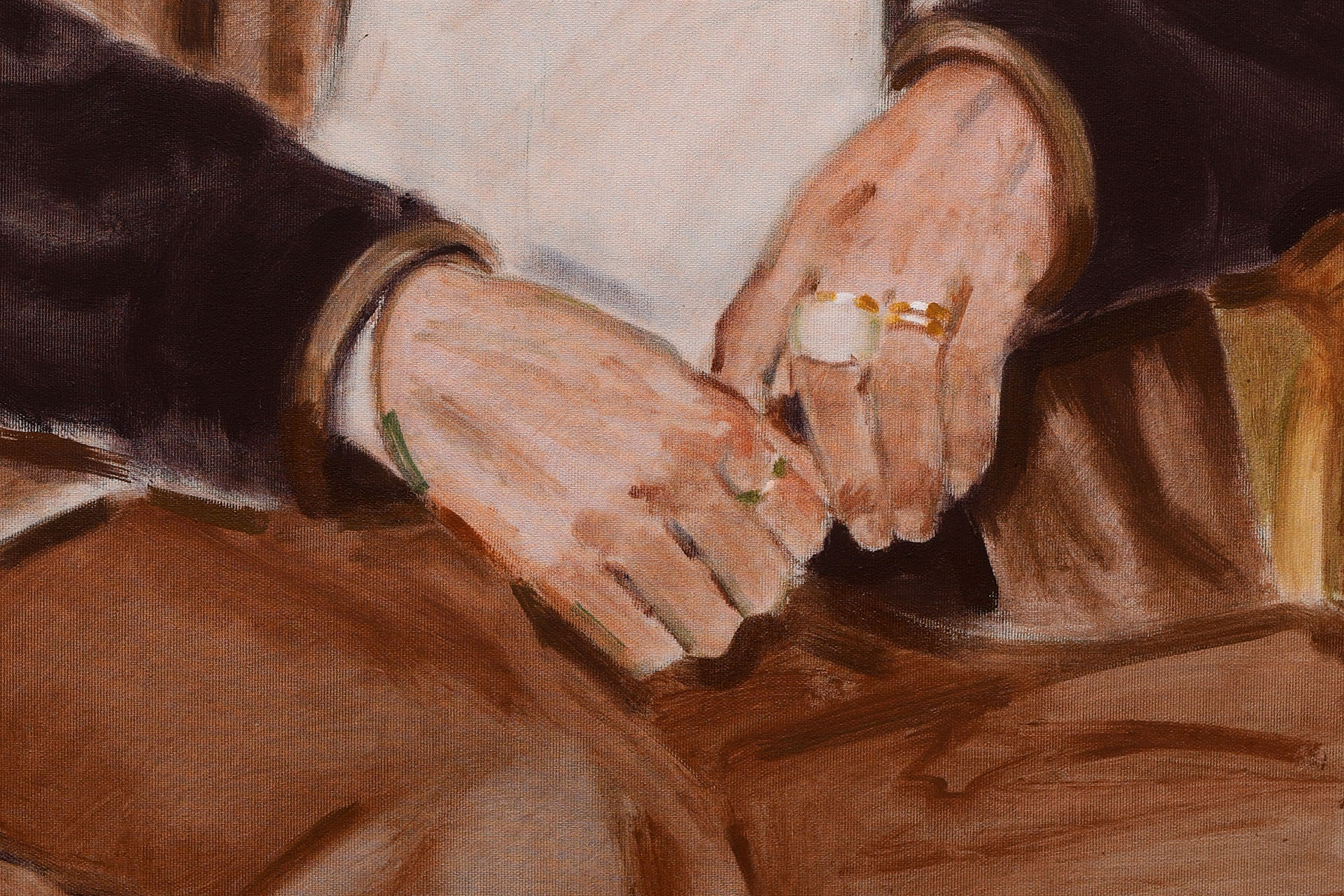
The brushwork itself remains open, at times loose, allowing a degree of indeterminacy to persist. Rather than capturing his subjects through photography, the artist works from videos, seeking presence rather than a specific pose. His “qualityless” figures (that is, devoid of heroism) nevertheless lend a particular quality to the space they occupy. Their discreet and restrained energy places them at a certain distance that is not one of superiority but of modesty.
Bitton’s work thus goes against the grain of a visual culture saturated with fast-paced, instantly comprehensible images. Instead, it embraces a form of minimalism. In this almost monastic simplicity, the painting becomes a focal point. In some respects, it brings to mind the meditative simplicity of Fra Angelico, with whom he seems to share a similar artistic rigor.
What is at stake in these works is perhaps not so much the representation of a subject as the emergence of a presence—fragile, attentive, always somewhat elusive—that can only be approached through a patient gaze. To those who are willing to linger, these paintings gradually offer a form of silent familiarity, like an invitation to slow down and, over time, experience a different way of seeing.
– “L’attention des images”, Gatien DU BOIS
All the World’s a stage,
And all the men and women merely players;
William Shakespeare, As You Like It (Act II, Scene VII), 1623
By spending time in what could be called a setting, conceived by Charles Laib Bitton in Irene Laub’s exhibition space, one gradually becomes aware of one’s own presence in its architecture. Reconfigured by the artist, the space hosts a whole new series of works designed to fit tailor-made panels covering all of its walls and doors.
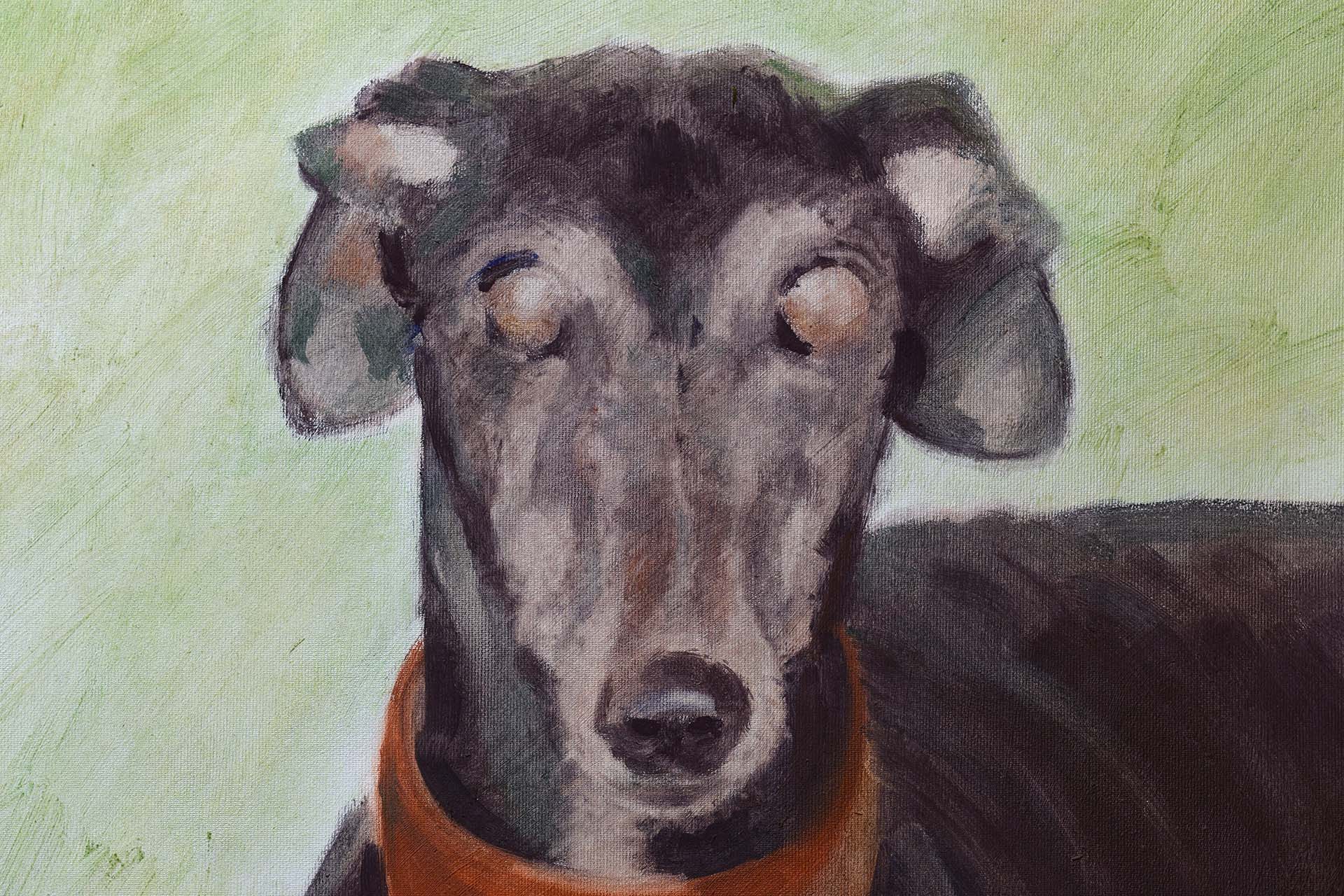
We enter a gallery of larger-than-life portraits. A young woman, a man, a cat, a plant – each creature is given the same visual value, perhaps the same weight. No hierarchy distinguishes them, they co-inhabit as the elements of an ecosystem, as bit players on a film set, as the characters of an opera chorus.
All the human figures are seated on the very same cane chair posed on the very same tile-floor. They seem to gaze at us from an intimate place, a private cabinet perhaps, where moods are allowed to flow and thoughts to wander.
Their gaze is at once fierce and introverted, present and absent, provoking an unsettling, uncanny experience. As onlookers, we are reminded of our own physical body – perhaps vicariously standing for the artist’s agency – acting as a performative, crystallizing entity within this display of characters.
From Untitled, Florence, 2025 to Untitled, Florence, 2026, the titles of the paintings span the sequence of a year’s work in the artist’s Florence-based studio.
Stemming from this specific moment and place, Charles Bitton conceived a site-specific, global installation, portraying both the human and non human elements he daily interacts with. The nameless models evoke as much the contingency of their existence as the elusiveness of the captured moment in time.
If art is a thing of the mind – cosa mentale – as Da Vinci suggested, Bitton’s paintings and their very matter convey atti e moti mentali – mirroring perhaps both the model’s and the artist’s attitudes and motions of the mind.
Embodying a third party, the viewer acts as the moving tip completing a virtual triad.
Embracing a subtle richness of nuances, the oil paintings are surprisingly all made with a limited color-palette of four pigments. This constraint seems to be part of the artist’s intent to work with a set of simple rules allowing him to create a unified ensemble: a limited set of dimensions and colors, converging towards a quasi religious Trinitarian symbolique.
And indeed the portraits are surrounded by frescoes holding a motivic, abstract shape, envisioned by the artist as the symbol of a unified life on earth.
As for the course of the paintings after the show at the gallery, a precise protocol has been designed to allow both the acquisition of each painting separately, and the reuniting of the installation as a whole – notwithstanding its scattering in space and time – thus preserving the possibility of its unity.
– “Theatrum mundi”, Tania NASIELSKI
As one crosses the threshold of the exhibition, the body slows down. The walls recede behind tall seated figures, that frontally observe us. The space ceases to be a mere gallery; it generates a presence that absorbs us. The ensemble is reminiscent of the tradition of the great painted cycles of the Italian Renaissance, in which bodies enveloped the viewer and transformed painting into a spatial experience. Here too, painting becomes a place one enters and inhabits. The installation is less a succession of paintings than a conditioning of the gaze, conceived at the scale of the body. The architectural dimension runs through several of Charles Laib Bitton’s recent projects, where partitions, self-standing panels and pathways transform painting in a living environment rather than a simple surface hung on a wall. The work does not merely occupy space ; it structures it, making us active participants within it.
In the Florentine apartment where the artist lives and works, people, known to him or not, come and take place in the same rattan armchair. They sit, hold a pose, remain in the light for a moment. The scene is filmed, and the pictorial process follows. The work alla fresca imposes a quick and irreversible rhythm : it is in the gesture itself that painting finds its grace. Inherited from the Italian tradition, this technique inscribes the work in the very time of its execution.
The painting never reproduces the filmed image : it displaces, transforms, and reactivates it. Between the lived experience, its recording and its pictorial translation, something subtly untangles. What appears on the surface is less a faithful restitution than it is a sensitive reconstruction, permeated by memory. Here, we find affinities with certain tendencies in contemporary figurative painting, notably those of Luc Tuymans and Michaël Borremans, where the image does not seek to reproduce reality, but rather to bring forth the trace of a lived experience. The work is not limited to what is visible, it rests upon a protocol that has been composed of a number of steps – posing, recording, painting – that never fully coincide. Painting becomes the site of their encounter. In this sense, it aligns with what Rosalind Krauss has described as an “expanded field” in which the medium is no longer autonomous and enters into relation with the body, time and the dispositive.
This economy of means comes hand in hand with a remarkable attentiveness to the represented subjects. Children, adults, animals, plants and objects seem subjected to the same gaze, with the same intensity. No landscape really situates these figures. The outside world remains absent, whereas the Italian tradition still inscribed the body within a larger world. The palette fully participates in this tension. Only a few colors are used, drawn from the Tuscan earth, ochre, muted red, deep green and brown. This deliberate, almost austere restriction makes the surfaces vibrate and subtly displaces the figure beyond strict realism. Hues blend into each other; green emerges within the shadows, red courses through the flesh, ochre captures the light without every fully fixing it. The colors construct unstable presences, as if each skin held the diffuse memory of another time and place, yet remained entirely present.
As shown by Georges Didi-Huberman, certain images derive their force precisely from this “active anachronism”, in which disjointed times persist together, and multiple temporalities coexist. The model of the fresco carries a long, historical time, while the bodies and faces belong to the present moment. It is within this tension that the power of this installation resides. And so, when one leaves the exhibition, the figures continue to accompany one’s memory, to the point where it becomes impossible to know whether they belong to the painting or to one’s own history.
– Barbara CUGLIETTA
PRESS :
- La chambre des regards de Charles Laib Bitton, Gwennaëlle Gribaumont in La Libre, 29.04.2026 (FR)
- Charles Laib Bitton, L’Écho des Présences, Gwennaëlle Gribaumont in L’Éventail, May 2026 (FR)
- Sélection Galeries, Gwennaëlle Gribaumont in COLLECT, Summer 2026 (FR)
Opening Wednesday 22.04.26, 5pm > 9pm
Exhibition until Saturday 04.07
Location
Irène Laub gallery
29 rue Van Eyck
1050 Brussels (BE)
Read more about Charles Laib Bitton.